












Medieval Japan
This system was based on the relationship between feudal lords (Daimyos) and warriors (Samurai), where power was decentralized and loyalty and military service were exchanged for rewards.

In feudal Japan, there was a rigid system of social classes, the "factions," established during the Edo Period (1603-1868). This social hierarchy, which was determined by birth, specified an individual's occupation, status, and life opportunities.
The social pyramid of feudal Japan was organized as follows:
- Emperor and Nobility: at the top of the hierarchy, the emperor was a symbolic and religious figure, but without real political power. Power was exercised by the Shogun, the supreme military leader;
- Shogun: the military commander who actually governed the country;
- Samurai: the warrior class that served the Daimyō, the feudal lords;
- Peasants: at a level below the Samurai, the peasants were the largest part of the population. Their high social position was due to their importance in rice production, the basis of the economy.
- Craftsmen: Below the peasants, craftsmen were considered less important than those who produced food.
- Merchants: Merchants were at the lowest level of the recognized social classes. Although some accumulated great fortunes, they were viewed with disdain because, according to Confucian thought, they produced nothing themselves, only transported goods.
In Samurai, each player is a Daimyō seeking to forge alliances with three factions: samurai, peasants, and priests, in order to gain the Shogun's support.
Samurai - Game Info
Samurai is a 2-to-4 players game, age 10+, by designer Reiner Knizia. Art by Franz Vohwinkel, Miguel Valenzuela Beltrán, Xu Yunxiang, Li Xiaona, Yang Jingwen, Xie Youxin, Chen Jie and Guo Ziying.

Samurai was released in 1998 by Fantasy Flight Games, and in Brazil in 2009, by Ceilikan Jogos. Its mechanics include: collecting sets, model building, and dice rolling.

Samurai has been a standout since its release year; here are a few of its achievements:
- In 1998, it won the Meeples Choice Award;
- In 2011, it won the JoTa award for Best Game Released in Brazil;
- In 2017, it was a finalist in Spain for Game of the Year.
Let's get to the game!
Playing the Game
We are in feudal Japan, and to gain the favor of the Shogun, we must fight to win the support of most of the factions, consisting of the samurai, peasants, and priests. This struggle will be fought primarily on land, but can also be held at sea, and with very precise strategic moves, the coveted support can be won.
This is the setting of Samurai!
Samurai is a classic board game with clear and simple rules, yet with deep strategy, one of the greatest successes of the world-renowned designer Reiner Knizia, and perfect for all kinds of players.
Samurai is set in medieval Japan. Players compete to gain the favor of three factions: samurai, peasants, and priests, which are represented by helmet, rice paddy, and Buddha figures scattered about the board, which features the islands of Japan.

The competition is waged through the use of hexagonal tokens, each of which help curry favor of one of the three factions — or all three at once! Players can make lightning-quick strikes with horseback ronin and ships or approach their conquests more methodically.
The hexagonal tokens are 20 in total, for each player, and they come in 8 different types:
- 3 Helmet tiles with strengths 4, 3, and 2;
- 3 Rice Paddy tiles with strengths 4, 3, and 2;
- 3 Buddha tiles with strengths 4, 3, and 2;
- 5 Samurai tiles with strengths 3, 2, 2, 1, and 1;
- 1 Ronin tile with strength 1;
- 3 Ship tiles with strengths 2, 1, and 1;
- 1 Token Exchange;
- 1 Figure Exchange.

During setup, the number of players indicates the size of the map and the amount of each of the Helmet, Buddha, and Rice Paddy figures that will be scattered across the map.

Then, each player receives a screen and its 20 tokens , shuffles them face down, draws 5 of them, and places them behind their screen to use them on their turn.

Game time! The turn consists of 3 stages:
- Stage 1: Place tokens on the board;
- Stage 2: Check if any figure was captured;
- Stage 3: Redraw until you have 5 tokens .
Stage 1 is your opportunity to place tokens on the board. Simply choose which of the 5 available you will use, with some restrictions:
- Normal pieces: You can only use 1 of them per turn:* Helmets, Buddhas, Rice Paddies, Samurai, and Token Exchange;
- Special pieces: Unlimited use per turn:* Ships, Ronin, and Figure Exchange. They all share a Japanese character symbol to identify them.

In summary, you can use only 1 normal token and as many special tokens as you want on your turn. However, some of them have peculiarities:
- Ship tiles can only be placed at sea;
- the Token Exchange token stays on the map in place of the token that is immediately relocated to another location on the map;
- the Figure Exchange token is removed from the game when used.
The Token Exchange token and the Figure Exchange token are very easy to identify by their self-explanatory iconography.

After placing your piece(s) on the board, you must check if any figure has been captured, this corresponds to Step 2. To do this, observe if the figure around the token you just placed is completely surrounded by tokens.
Regarding the siege, there is an important detail: for the purpose of a siege, it is sufficient for the figure to be completely surrounded by land to be considered captured. Ship tokens, if present in the siege, obviously count towards the total strength, but are not mandatory to set up the siege.
To know who won the siege and will capture the figure, simply calculate the forces. Add the strength values of the tokens of each player's color, however, there are some particularities here as well:
- the Helmet, Buddha and Rice Paddy tokens only add strength to their respective figures;
- the Samurai, Ronin and Ship tokens add strength against any figure.
Let's look at an example using the following image, where the Rice Paddy figure has been surrounded:
- The green player has a total strength of 3, formed by the sum of the Samurai and Ship tokens, which contribute to capturing the Rice Paddy figure. The Buddha token, with a strength of 4, is not included in this count, because what is being surrounded is a Rice Paddy figure, not a Buddha figure. This Buddha token will actually contribute to the Buddha figure siege, right above it.
- The red player has a total strength of 5, composed of a Rice Paddy piece with a strength of 2 and a Samurai piece with a value of 3, which reinforces the capture of the Rice Paddy figure.

Therefore, the red player takes the Rice Paddy figure.

If there is a tie in strength, no one receives the contested figure; it is removed from the Board and set aside. This is important because the number of figures set aside from the Board due to a tie is one of the criteria for ending the game.
Finally, in Phase 3, complete your tokens. Randomly pick tokens and place them behind your screen until you have a total of 5 again.
That's a turn of Samurai!
Ending the Game
When the last figure of any type (High Helmet, Buddha or Rice Field) is captured from the board (by either a player or set beside the board because of a tie), the current player’s turn is finished and then the game ends.
The game also ends when the fourth figure is placed beside the board when captured due to a tie. As before, the current player’s turn is completed and then the game ends.
When the game ends, all players remove their screens and count the number of figures of each type.
If any player has captured the most figures of 2 or 3 types, they are the immediate winner!
If there is no immediate winner, all players who have captured the most (ties for the most do not count) of one type of figure are eligible to win; players with no “most” cannot win. Players with the most of a figure set aside those figures and count the number of other figures they captured. The player with the most other figures is the winner!
If there is a tie, the tied players count all their captured figures; the player with the most is the winner! If there is still a tie, the tied players share the victory. If no player has the “most” of a figure, the player with the most captured figures is the winner.
Strategy Tips
Samurai is pure strategy, and you need to keep an eye on several sieges happening on the board.
There are many ways to win in Samurai, some obvious and others more strategic:
- placing a Rice Paddy token surrounding a Rice Field figure, this is doing the obvious, BUT
- placing a Rice Paddy token between 2 locations where a Rice Field figure is in dispute, this is strategic.
The following image shows exactly the example mentioned above, circled in yellow, the red player's strategy was to place a Rice Paddy token between 2 locations where a Rice Field figure is in dispute. Thus, this token, strategically placed, will add strength to both sieges.
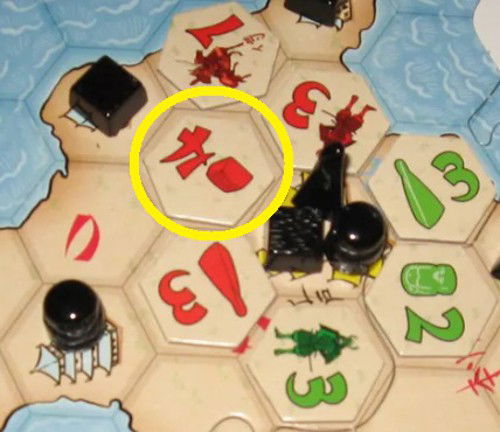
This strategy can, and should, be used with the "special" tokens, as they offer much more ease and flexibility for this purpose. After all, they support all other tokens, regardless of the type of figure being contested. This will greatly help your game.
Regarding the "special" tokens, since there's no limit to their use per turn, use as many as you want and can. Use this to complete a siege; you can surprise your opponents.
I recommend, for the heavy gamers out there, counting the tokens during the game. This elevates the game's strategy to another level, and moreover, counting the figures in play and those captured will make things "serious," and your chances of victory will increase exponentially.
Try to have a majority in at least one faction, but know that even then, this doesn't guarantee you'll reach the "final," as an opponent could have a majority in the other two factions and thus win the game!
Two more things to pay attention to:
- Number of figures outside the Board due to draws;
- Number of figures of a faction still on the Map Board.
I say this because both cases can trigger the end of the game; it's good to have some support to win or, at least, go to the "final".
Based on these tips, develop your best strategy and win in Samurai.
Unboxing, Rules, and Gameplay Videos
Unboxing:
Rules and Gameplay:
Pedagogical Tips
If you're looking for a highly strategic, language-independent game that provides excellent stimulation for your child, Samurai is the game for you!
Managing resources will be necessary when managing your tokens behind your screen, deciding which ones to use and/or keep for the next turn. This involves the concept of decision-making. Management and decision-making go hand in hand.
Logical-mathematical reasoning is present at all times, as it's necessary to add up the values of the forces in dispute for a figure. Note that this also impacts the management and decision-making regarding which token to use.
Spatial orientation is also key, as it's necessary to analyze the locations still in dispute, combining this concept with others to finally decide which battle to enter.
In a lighter and more pedagogical way, the children will find themselves constantly competing for space on the map board and for captured figures. It will be an excellent learning experience through stimulation and fun.
Pedagogically, Samurai, from the resource management class, stimulates strategy, decision-making, logical-mathematical reasoning, spatial orientation, and on top of that, it's fun!
I recommend Samurai for your collection!








 Inicia sesión y únete a la conversación
— Comentarios 0
, Reacciones 1
Se el primero en comentar